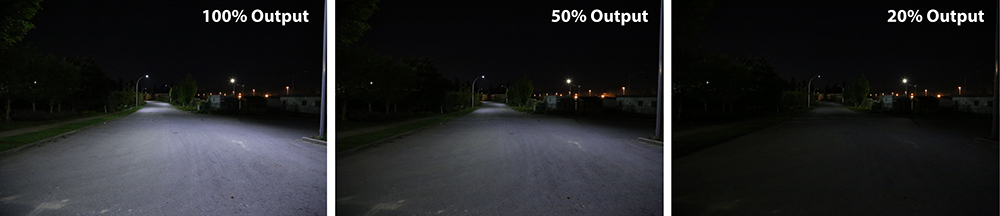
For the purposes of evaluation DMD have LED street lights and an adaptive lighting control system installed on the roadway fronting their office. The City of Surrey’s lighting requirements for this local road with a low pedestrian activity is 0.3 cd/m². End of life light levels (at 20 years) with these LED’s are calculated to be 0.65 cd/m². Current light levels are more than twice the required levels at 0.74 cd/m². The adaptive controls allow lighting levels to be adjusted remotely via software and a computer.
Earlier in the year DMD conducted a study where lighting was dimmed from full output (100%) down to 20% of full output in 10% intervals. A group of volunteers were assembled to review the visibility impacts of the dimming. The vast majority of those partaking in the study found no significant loss in visibility until the lighting was dimmed to 20% of the current output (80% reduction). To put this in perspective, after dimming to 20%, the light levels were only half of the required lighting level of 0.3 cd/m².
The Virginia Tech Transportation Institute (VTTI) have conducted similar studies and found similar results at an 80% reduction of light output. These studies are significant in defining the range of allowable dimming for LED lighting systems.
These results show great potential for dimming street lights leading to significant energy savings. DMD will continue to study and assess adaptive control systems which will lead to recommendations on the implementation of dimming street lights.